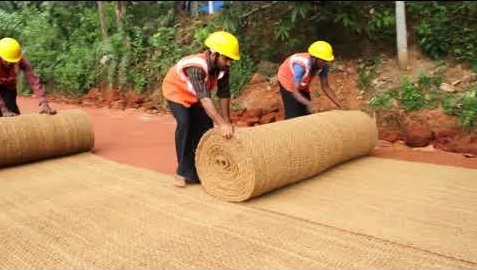
Coir geotextiles in roads – The transportation infrastructure is related to the economic development of a country. Most rural roads are unpaved and are the primary form of the road network. The significant problems these roads face are they are built in weak subgrade and subbase/base-coarse. The primary function of geotextile materials includes filtration, separation, and reinforcement.
The geotextile behaves as a tensioned membrane and reduces the vertical stress acting on the subgrade. The placement position of support is a primary factor affecting the bearing capacity of reinforced granular soil. Higher bearing capacity has been observed when the reinforcement placement depth is decreased. The reinforcement can also yield reductions of pavement thickness between 20% and 50% with obvious favorable economic repercussions.
The benefits of reducing base course thickness are realized if the cost of the geosynthetics is less than the cost of the reduced base coarse material. In developing countries like India, the price and availability of geosynthetics are the major constraining factors for pavement construction.
Paved The Roads and Reinforce Soil Structure using Coir Geotextiles in Roads
A typical reinforced unpaved road consists of a layer of fill compacted into the subgrade with a single layer of geosynthetic reinforcement (geogrid or geotextile) placed at the base of the fill. It is also concluded that geosynthetic support is particularly effective when the subgrade is weak. It is well known that natural materials will decompose over time, which limits their use to short-term applications only.
Since an unpaved road on a soft subgrade gets stabilized by soil consolidation due to the passage of vehicles, the time natural geotextiles support it. It is expected that joining the soft subgrade soil will make reinforcement unneeded in the long term. The presence of the reinforcement layer increases the fill material’s lateral restraint or passive resistance, increasing the system’s rigidity and reducing the vertical and lateral pavement deformation.
Reinforcement placed high up in the granular layer hinders the lateral movement of the aggregate due to frictional interaction and interlocking between the fill material and the support, which raises the apparent load-spreading ability of the total and reduces the necessary fill thickness.
Maybe you like to read the following article Coir Roll Matting Helps Maintain Sloping Ground in Watershed Areas
Coconut Fiber are Designed for Roads
Coir geotextiles design good interface friction with granular fill, which can induce tensile stress in the support when embedded within the fill material. Such minor modifications in horizontal stress allocation can cause significant changes in system performance. Hence, when used as reinforcement in unpaved roads, laying of coir geotextile must be carried out to take full advantage of this biodegradable material during the early period of structure when much of the working of membrane action cannot be predicted.
The presence of the reinforcement layer also markedly increased the load spreading angle compared to the unreinforced one. The article shows that including coir geotextile as reinforcement in soil improves the ratio of lateritic soil.